Meditations

Putin and the Spies

by Alex Wellerstein, published February 27th, 2012

Recently, Russian Prime Minister Vladimir Putin praised the work of US spies in helping the Soviet Union get the atomic bomb. Reuters quotes him:

You know, when the States already had nuclear weapons and the Soviet Union was only building them, we got a significant amount of information through Soviet foreign intelligence channels. … The were carrying the information away not on microfilm but literally in suitcases. Suitcases! … It was the cream the scientific world that was gathered in America, and I personally have gotten the impression that they consciously gave us information on the atom bomb. … They did this consciously because the atom bomb had been used on Hiroshima and Nagasaki and scientists from mankind’s intellectual elite at the time understood what unilateral possession of such a weapon might lead to.1

The sum total of context given is that he told this to “military commanders.” Not a whole lot to go on. Why’s Putin praising spies? I mean, it’s not a huge stretch for the former FSB chief, but a little more background would be nice.

The original story on ITAR-TASS (the state news agency) doesn’t tell too much more context, either, though it describes the immediate context as being about the need to maintain a strategic balance with the United States (not just praising spies for their own sake). Interestingly, there are two Putin quotes left out of the English-language versions, and they go some of the distance in contextualizing these remarks a bit more.

Read the full post »

  1. Steve Gutterman, “Putin Praises Cold War moles for stealing U.S. nuclear secrets,” Reuters (22 February 2012). []
News and Notes | Visions

NUKEMAP at One Two Three Four Five Six Seven Eight Nine Million “Detonations”

by Alex Wellerstein, published February 23rd, 2012

I woke up this morning to find that NUKEMAP had hit well over one million “detonations.”

Remember when I was very impressed that I had 1,500 detonations? Yeesh.

These have been spread over about 190,000 unique visitors. The average of ~5 “detonations” per visitor has held pretty solidly over the last week.

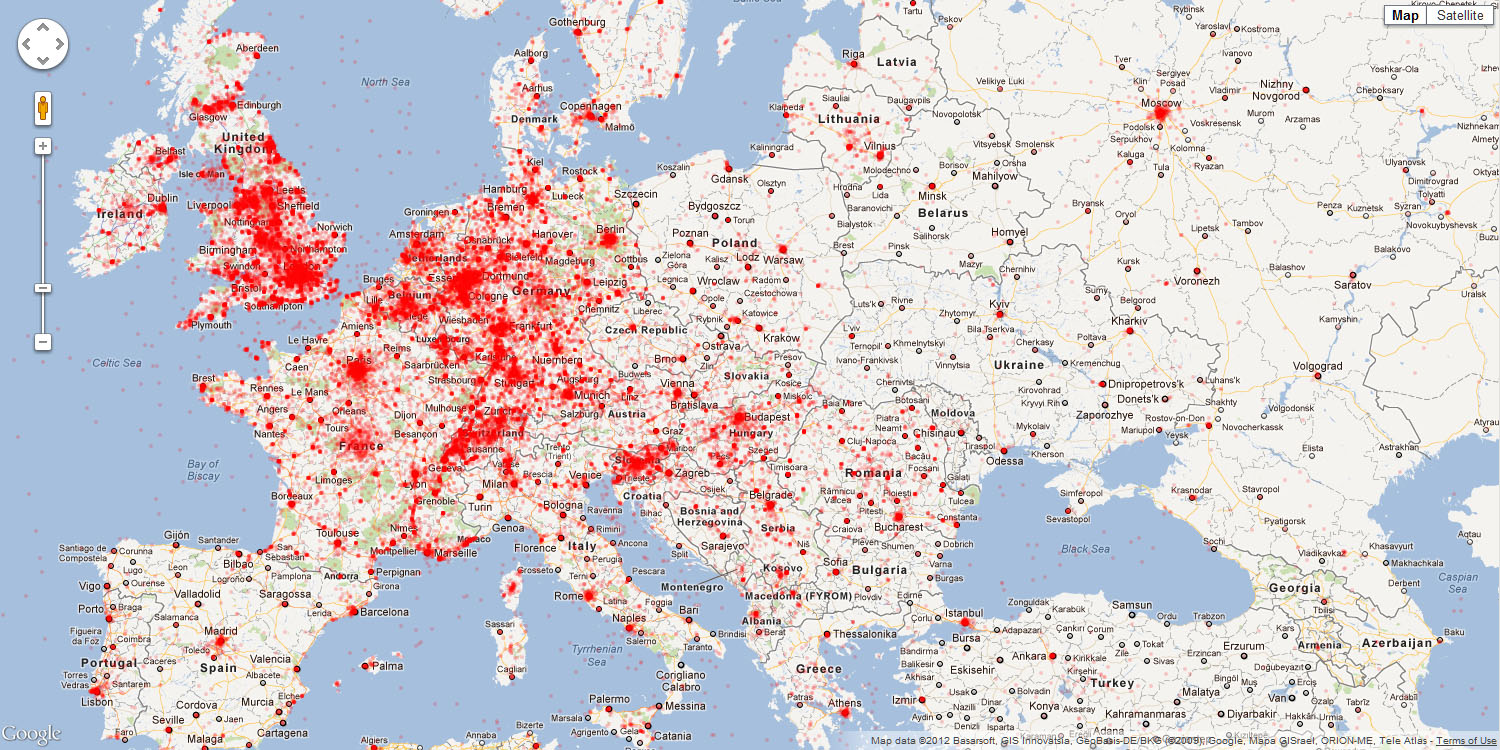
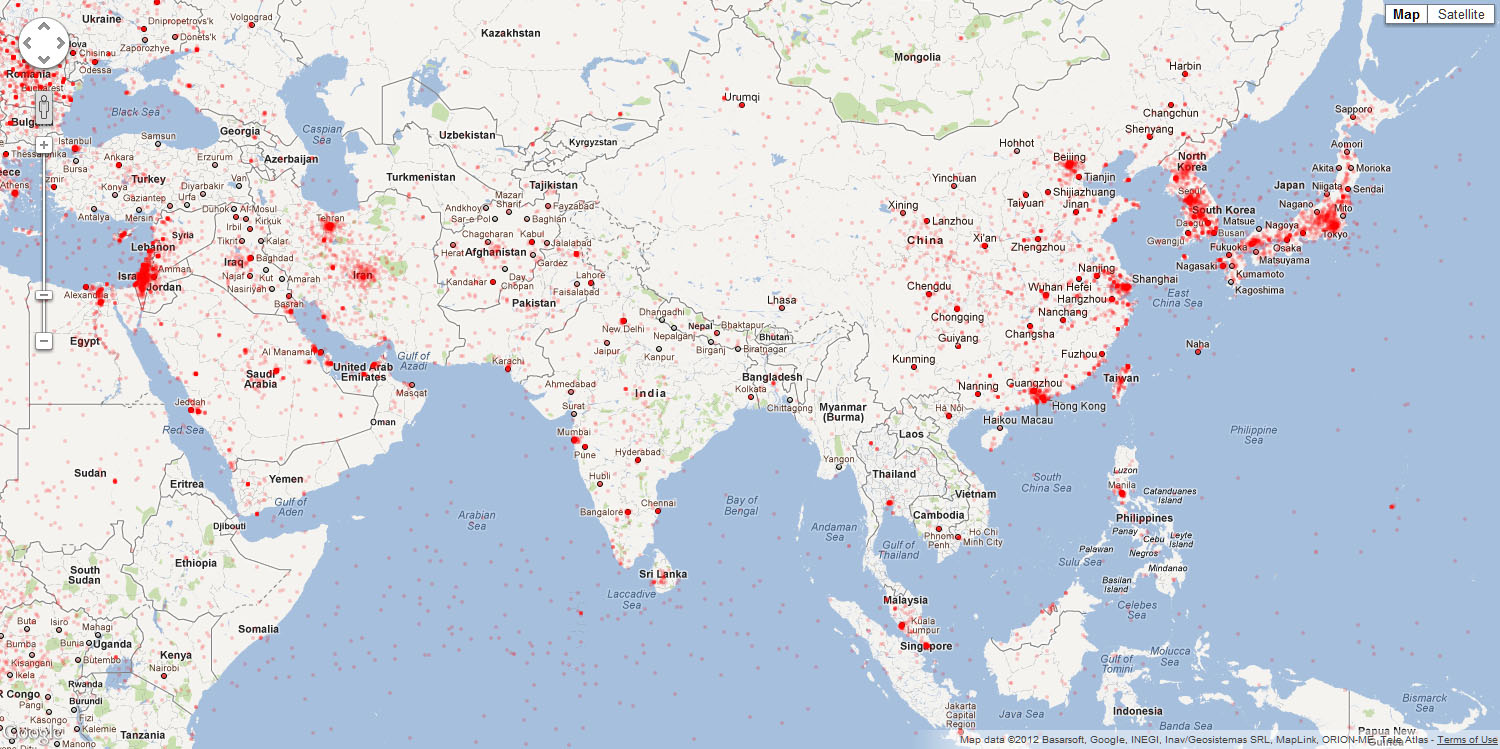
Here are some visualizations I threw together showing where those million-and-change detonations fell. Each of the dots has an opacity of only 25%, so when they look bright red, that means they’re being stacked on top of each other. I’ve also thrown out any perfectly redundant data, so nuking the exact same spot repeatedly doesn’t change how it is rendered.

Click the image to zoom in. For details of various regions, click here: the USA, Europe, Asia and the Middle East, South America and Africa, and Oceania.

I will be soon writing up a somewhat formal analysis of this data, and other feedback I’ve gotten as to how NUKEMAP was used, talked about, spread around, and so on. I’ll let you know when it’s up.

Until then, Tom Lehrer will serve as analysis-by-proxy:

After the jump is a brief NUKEMAP FAQ of sorts, based on various blog comments, forum posts, news stories, and so on that I’ve seen on this.

Update: It’s only 2/26 (three days after I wrote the above) and we’re already at the second million. If I had a nickel for every Tsar Bomba dropped… well, I’d have about $25,000. Update: NUKEMAP hit three million around 3/6. Update: NUKEMAP hit four million sometime around 4/12. Update: NUKEMAP hit five million sometime around 7/12. Update: NUKEMAP hit six million detonations on 8/27 (another round on Reddit). Update: NUKEMAP hit seven million detonations on 10/22 (Reddit, again). Update: NUKEMAP hit eight million around 10/29 (tail end of that Reddit traffic). Update: Nine million around 12/22/12 (Reddit again).

I’ve written up an analysis of 4.3 million “detonations” and their locations for the online journal WMD Junction. Check it out.

Read the full post »

Redactions

The Infamous Teller-Ulam Report (1951)

by Alex Wellerstein, published February 22nd, 2012

Enrico Fermi came up with the basic idea using the power of a fission bomb to ignite fusion reactions — a thermonuclear or hydrogen bomb — as early as 1941. He told it to Edward Teller, who, as is well known, ran with it. For the next decade, Teller would commit a significant amount of his time to the effort of trying to figure out how you could make such a thing actually work.

That it took Teller — and everyone else at Los Alamos — a full ten years to figure out how to solve the problem is a good indication that it was a very hard problem. At the very least, it required a familiarity with nuclear reactions at energy regimes which had never been achieved previously on Earth. It also required breaking out of several wrong ideas along the way whose wrongness was not obvious.

There has been a lot written about the developments that led to the Teller-Ulam, or Ulam-Teller (as many fashion it), design in the spring of 1951. I find it more than a little fascinating that this old Cold War priority dispute is still alive and well in some circles, and have myself written a talk (which I probably ought to push to publication) with musings on the subject.1

Contemporary portraits of Edward Teller (by George Gamow) and Stanislaw Ulam (by Shatzi Davis).

The most basic form of it is that Stanislaw Ulam, a Polish mathematician, had considered that you could put a fission bomb into a heavy “box,” set it off, and use the explosive pressure and heat of the blast to compress a larger piece of fissile material to very high densities. This would result in a very, very powerful (and very “dirty” from a fallout perspective) fission weapon, probably in the megaton range if you did it cleverly enough. Ulam told this to Teller, who jumped on it. As Ulam famously wrote to John Von Neumann: “Edward is full of enthusiasm about these possibilities; this is perhaps an indication they will not work.”

Teller realized that the X-rays of the exploding fission “primary” were much faster than explosive forces Ulam was relying on, and could be used to compress fusion fuel to very high densities well before the bulk of the fission bomb’s heat reached it. Somewhere along the line he also put a fission “sparkplug” inside the fusion “secondary,” adding additional compression of the fusion fuel. Ergo, the multi-megaton hydrogen bomb. (Wikipedia, as you can imagine, has a long article on this thing, should you find my technical description lacking in detail.)

There’s much, much more to it than this thumbnail sketch.

The result of all this, though, was a report signed by Teller and Ulam titled “On Heterocatalytic Detonations I. Hydrodynamic Lenses and Radiation Mirrors,” report # LAMS-1225, dated March 9, 1951. Quite a mouthful. We’ll get to the “heterocatalytic” in a moment, but the “hydrodynamic lenses” are the initial Ulam compression scheme; the “radiation mirrors” is related to Teller’s insights with regards to radiation implosion. Presumably.

I’ve seen this report cited about a million times as “the” report, so I was surprised to find that there was a copy floating around online. Before you get too excited (or before my government readers flip out) the report is heavily redacted. Only a few paragraphs remain unadulterated, but it’s still pretty interesting.2

Click to view the full PDF.

Some close-reading thoughts follow, as well as a probably explanation for why the “Ivy Mike” shot cab was called “the Sausage.” (It’s probably not the reason you’d think it was.)

Read the full post »

  1. The portraits were scanned from George Gamow, My World Line: An Informal Autobiography (New York: Viking Press, 1970), on 153. []
  2. Citation: Edward Teller and Stanislaw Ulam, “On Heterocatalytic Detonations I. Hydrodynamic Lenses and Radiation Mirrors (LAMS-1225),” (9 March 1951), Los Alamos National Laboratory, retrieved from http://www.nuclearnonproliferation.org/LAMS1225.pdf. []
Meditations

Domesticating Los Alamos

by Alex Wellerstein, published February 20th, 2012

One of the things I’ve always found interesting is the emphasis on the social activity that took place at Los Alamos during the Manhattan Project. Parties, lab alcohol, skiing… why is this such a key component in the story of the bomb?

This came up again recently because some new footage has been found of various Los Alamos folk romping around during World War II. It’s kind of amusing, I suppose. We have Hans Bethe on skis, Robert Serber riding a horse, and “OPEN-heimer” aka “OPE-ie” drinking a “martini” (quite clearly champagne).

Longtime Manhattan Project buffs are of course not really surprised by this. Jon Else already covered this ground pretty well in The Day After Trinity, and any Oppenheimer biography goes into great detail about what a great host he was supposed to be and how cold his martinis were (he gets a lot of credit, I might point out, for just using adequate amounts of ice).

But why? The news director and the LANL reps they quote seem to imply that this “humanizes” the bomb scientists. I wonder how much that gets us, intellectually and rhetorically.

Who are we “humanizing” them to, and what are we “humanizing” them against? Is the fear that people will think they are mad scientists of some sort, or people totally disconnected from regular human life, or disconnected from the consequences of their work?

Read the full post »

Visions

Nuclear Bombs, Soviet Style (1958)

by Alex Wellerstein, published February 17th, 2012

This set of Friday Images comes from an obscure Soviet publication I tracked down on a trip to the Library of Congress a few weeks ago. I had been searching for this for awhile, since I knew that the Army had paid to translate it quite some time ago, but the Army translation was itself a bit hard to track down. I really just wanted it for the images — it’s one of the few Soviet books that I’ve seen which purports to explain how nuclear weapons are designed, and I’m always curious how they went about that sort of thing.

The book is titled Termoyadernoye Oruzhiye (Thermonuclear Weapons) and is by M.B. Neiman and K.M. Sadilenko. Neiman (or Neyman, depending on your transliteration preferences) is listed on the frontispiece as a doctor/professor of chemical science, and Sadilenko is listed as some kind of “research associate” (научный сотрудник) of the Soviet Academy of Science. The volume was published by the Ministry of Defense for the USSR, in Moscow, 1958.

The two bomb drawings I’m most interested in are their depictions of implosion and the hydrogen bomb. The basics of the implosion design had been declassified in the United States as early as 1951, and by 1958 there were lots of depictions of its more-or-less correct operation (using chemical explosives to compress a solid or hollow core). In the Soviet Union, though, they usually drew implosion differently. Here’s the Neiman and Sadilenko version, which is more or less the only way I’ve seen it depicted in the Soviet literature:

“Fig. 9. Schematic diagram of the atomic bomb (the charge is split into several parts): 1 — explosives; 2 — plutonium; 3 — neutron source; 4 — neutron reflector; 5 — shell (tamper)”

It’s a curious design — almost implosion, but not quite. It depicts shooting a plutonium core together into a spherical configuration, not compression through explosive lenses. It’s actually quite similar to the “pre-implosion” design depicted in the Los Alamos Primer (second from the top here).

The hydrogen bomb diagram is even more amusing:

I’m not going to type this caption out, but basically the idea is that this is a fission-fusion-fission weapon, where you have multiple fission primaries surrounding a large amount of fusion fuel. See the image below for a more-or-less similar English translation.

Now this isn’t the world’s worst H-bomb drawing for the time. The Teller-Ulam design wasn’t known publicly until 1979, so for 1958, this is pretty good. The key feature that sticks out as wrong is the fact that there are at least seven fission primaries here, which is a bit excessive (the real Teller-Ulam design uses one). But other than that, not too bad — it has the final “dirty” U-238 fission stage, and seems to get that external compression (rather than internal compression, as most H-bomb designs from the period show) is a key thing.1

But this drawing isn’t Soviet at all in origin — it’s a complete rip-off of a drawing that appeared in a 1955 issue of Life magazine:

“3-F” here means “fission-fusion-fission.”

This drawing derives, I believe, from Ralph E. Lapp, who was really the first to popularize the idea that the fallout from the Castle Bravo accident (1954) implied that about 50% of the yield of hydrogen bombs was from a final, “dirty” uranium-238 fission stage.

This underscores an interesting dynamic throughout the Neiman and Sadilenko book: most of the drawings they have are ripped off of American sources… because the United States has long been the major producer of extensive speculation about how atomic bombs work!

There are also lots of charming Civil Defense drawings in this volume, which I’ll post more of at a later time. But for the moment, I’ll leave you with this wonderful little drawing of a Soviet street-washer decontaminating a bombed-out, post-apocalyptic city:

The little sign in the picture with “УБЕЖИЩЕ” written on it can be translated as refuge or shelter, but it can also be translated as asylum. Fitting, that.

  1. I’m using the terms “external” and “internal” a little idiosyncratically here, but what I mean is that the fission primary here is distinct and “outside” of the fission fuel. Contrast this with versions where the fission primary is surrounded by fusion fuel, or has “shells” of fusion fuel around it. The latter is like the Teller “Alarm Clock” model and the Soviet “Sloika” design, and was much more commonly depicted when people were speculating as to how H-bombs might work in this period. Before someone gets too picky, I’m aware that this lacks physical separation of the primary and secondary, that there is neutron shield for the secondary, that there isn’t an interstage, and that, of course, there’s no mention of radiation implosion in any of this. There’s still more wrong than right here. []