This week is, as you all no doubt know, the 67th anniversary of the bombings of Hiroshima and Nagasaki. These anniversaries happen to fall on the same days of the week as the original ones. So the bombing of Hiroshima on August, 6, 1945, was a Monday — just as with August 6, 2012. The bombing of Nagasaki, August 9, was a Thursday. The Smyth Report would be released on August 12, a Sunday. Hirohito’s “surrender” message would come on August 15, the next Wednesday.
For some reason, conceptualizing all of this as happening within a few weeks makes it seem awfully short in time. What a week that would have been.

Headline for the New York Times, August 7, 1945.
One of the things I really enjoy doing as an historian is looking through old newspaper front pages. You find so much out about past societies that way — the juxtaposition of related and unrelated articles provides a fascinating kaleidoscope of the day in question. Put a bunch of different newspaper headlines together, from different parts of the country, and you get an even more interesting portrait of a specific time and place.
In closing out the 67th anniversary of the Week of the Atom Bomb, I want to share a number of newspaper front pages with you. I’m limited in what I can conjure up, but I’ve managed to collect some 38 different front pages from newspapers in different parts of the country for the work week of August 6th through August 10th, each of which I thought was interesting or revealing in some way. Some of these newspapers will be immediately familiar to you — the New York Times, the Washington Post — some will be quite obscure — the Big Spring Daily Herald, from Big Spring, Texas, for example. Some represent quite specific markets: the Atlanta Constitution, for example, is an African-American newspaper in the age of segregation, and there are interesting differences between how they cover the issue versus the big city newspapers or the small town newspapers.
One additional point: the headlines are different, but the stories are almost exactly the same. This is because in the first week of the bomb, all of the stories were essentially written by William L. Laurence of the New York Times and released to the press by the Army. Not until the Smyth Report was released, on August 12th, do you start to see much independent reporting. The content of the “official” stories is interesting, but today I just want to focus on the headlines.
In an effort to keep this post from sprawling out forever, I’ve arranged all of the images in a little gallery below. If you are reading this on an RSS feed or an aggregator, you may have to visit the main site to view these.
August 8, 1945: The Boston Daily Globe, Boston, Massachusetts.
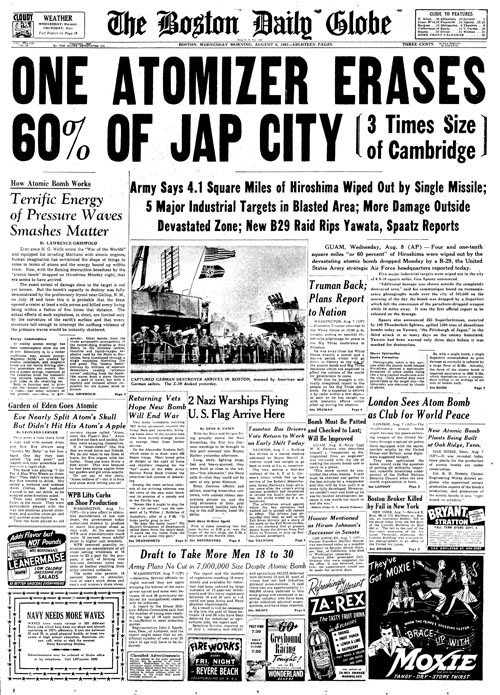
ONE ATOMIZER ERASED 60% OF JAP CITY 3 Times Size of Cambridge. This is after a preliminary assessment of been made of the Hiroshima bomb, which wasn't available the day before. I find the comparison with Cambridge fascinating: making sense of what was done far away by looking at the analogies of the local. There is a very bizarre article in the lower-left that is titled: "Garden of Eden Goes Atomic: Eden Nearly Split Atom's Skull But Didn't Hit His Atom's Apple." I'm not sure what to make of it -- it's a bizarre set of punnery ("We do not want to see them at home, for Eve argues with her hubby. Once she even through a dish atom! That was because he had been eating apples from her garden at got atom-acache.") that seems deeply inappropriate both for the front page of a major newspaper, much less relating to the story of destroying 60% of a city.


Thanks for putting this together. It’s a nice window into 1945 America.
[…] 6th is the 67th anniversary of the bombing of Hiroshima. Here’s a brief coverage of the week of the atom bomb, but there’s also posts on discussing whether a line was crossed and on biological warfare as […]
Thanks for sharing these. Really fascinating, and I loved your commentary. What was considered important, what wasn’t…the wide range of approaches…Wonderful idea.
[…] thought they could be really used, how they sketched them on the backs of steno pads, and how they danced across the headlines, and how the people who made them looked, even what color their eyes were, and how hard it is to […]
The reason many of the larger papers didn’t cover the Hiroshima bombing until the 7th is that they are morning papers. The announcement was made in time for the evening dailies, which is why their stories ran in Aug. 6 editions.
[…] news services. Two decades later, Science Service was one of the organs – along with the New York Times which had an inside scoop – that communicated the nuclear destruction of Hiroshima and […]